
Howard County Criminal Court Records
A criminal court record is the court file opened when a criminal charge is filed and assigned to a case. In Howard County, that record may start in the District Court of Maryland for misdemeanors, preliminary felony matters, bond-related stages, traffic offenses that carry possible incarceration, or other lower-court criminal work. Serious criminal matters, jury trials, indictments, felony trials, pleas, sentencing, probation violations, and appeals from District Court move through the Circuit Court for Howard County.
The record is kept by the court, not by the jail. An arrest may create booking and custody records through Howard County Corrections, while the criminal court record tracks the legal case. The narrower charge path is discussed on the Howard County arrest records and charges page. This file is the broader case record, including the charge, plea, hearing history, disposition, and sentence.
The Howard County State's Attorney is the local prosecutor. Maryland uses the title State's Attorney for the county prosecutor. The office prosecutes cases in District and Circuit Court, and the Office of the Public Defender provides eligible defense services for felony, misdemeanor, traffic, and juvenile delinquency matters where incarceration is possible.
Search Howard County Criminal Cases
Public criminal case summaries are searched through Maryland Judiciary Case Search. The portal can be searched by case number or party name and can show public fields such as case number, name, date of birth where available, party type, court, trial date, charge, and case disposition. For a full file or certified copy, the court that holds the record remains the official source.
- Open Maryland Judiciary Case Search and choose party name, case number, or advanced search.
- Use exact names first. If a partial last-name search is needed, use the first character of the last name followed by a percent sign.
- Confirm whether the case is in the District Court of Maryland for Howard County or the Circuit Court for Howard County.
- Open the case summary and read each charge, docket event, plea, hearing, disposition, and sentence entry in order.
- Request the complete file from the Clerk of the Circuit Court or District Court if the online summary is not enough.
For public defender qualification, Maryland Courts public-defender information says a person may apply at any District Court Commissioner's Office, and qualification status may be checked through Case Search.
Howard County Criminal Case Flow
Criminal court records should be read as a sequence. A case can begin with a complaint, information, or indictment. Then it can move through initial appearance, arraignment, motions, plea negotiations, trial, disposition, and sentencing. District Court and Circuit Court entries may appear at different points if a felony begins in District Court and later moves to Circuit Court.
Case flow: Charges Filed › Arraignment › Pretrial / Motions › Plea or Trial › Disposition › Sentencing
| Stage | What Happens |
|---|---|
| Charges filed | A charging document starts the court case and lists the alleged offense, statute, and filing court. |
| Arraignment | The court addresses the charges and the defendant's plea or next procedural step. |
| Pretrial / motions | Attorneys file requests, evidence issues are raised, hearings are set, and negotiations may occur. |
| Plea or trial | The case resolves by plea, bench trial, jury trial, dismissal, or prosecutor decision not to proceed. |
| Disposition | The record states the outcome of each charge, such as guilty, not guilty, dismissed, stet, or nolle prosequi. |
| Sentencing | The court records incarceration, probation, fines, restitution, conditions, or probation before judgment if ordered. |
Howard County Criminal Record Fields
A public criminal case summary may show enough to understand the charge path and final outcome. It may not include every filed document, exhibit, police report, or sealed item. The complete file can contain additional pleadings, orders, attorney appearances, sentencing papers, and clerk entries, subject to Maryland access rules.
| Field | What It Shows |
|---|---|
| Case Number | The court's unique file number for searching, docketing, and requesting copies. |
| Defendant | The person charged, with public identifiers only where Maryland rules allow disclosure. |
| Court | District Court, Circuit Court, appellate court, or another venue tied to the criminal matter. |
| Charge | The alleged offense, statute, and sometimes severity or charge count. |
| Plea | The defendant's formal response, such as guilty or not guilty, if entered and public. |
| Docket entries | Chronological events such as complaint filed, warrant issued, hearing scheduled, motion filed, or order entered. |
| Disposition | The outcome of each charge, including dismissed, nolle prosequi, guilty, not guilty, stet, or probation before judgment. |
| Sentence | Incarceration, probation, fine, restitution, conditions, or other sentence terms where public. |
| Warrant / bond | Public entries about bench warrants, bond, release conditions, recall, or related court action. |
Howard County Prosecutor and Defense
The Howard County State's Attorney's Office is at 9250 Judicial Way, Suite 2200, Ellicott City. Its main Circuit Court phone is 410-313-2108, its District Court phone is 410-313-3100, and the office email listed in the research is sao@howardcountymd.gov. The elected State's Attorney is Rich H. Gibson, Jr., and the office states that it prosecuted about 77,000 cases in District and Circuit Court in 2024.
The State's Attorney's role in the criminal court record appears through charging decisions, amendments, dismissals, pleas, trial events, sentencing positions, and victim/witness activity. The defense side may appear through private counsel or the Maryland Office of the Public Defender. The Howard County Public Defender office is at the Ellicott City District Court / Multi-Service Center, 3451 Courthouse Drive, phone 410-480-7777.
The prosecutor source helps place charge amendments, nolle prosequi decisions, and plea outcomes in the court record rather than in a police-only file.
Charges vs Convictions
A charge is an accusation filed into the court system. A conviction is an outcome after a guilty plea or finding of guilt. Howard County criminal court records may show charges that were dismissed, reduced, amended, placed on stet status, ended in not guilty, or were not pursued by the State's Attorney. Read each charge line separately because one case can have several counts and different outcomes.
| Point | Charge | Conviction |
|---|---|---|
| Meaning | An alleged offense filed by complaint, information, or indictment. | A court outcome based on plea or finding of guilt. |
| Record stage | Early or amended stage of the criminal case. | Final or near-final outcome for a specific count. |
| What to check | Charge text, statute, filing date, and status. | Plea, finding, sentence, probation, fines, and appeal activity. |
| Public meaning | Does not prove guilt. | Shows guilt was entered or found unless later changed by appeal or post-conviction action. |
Read Howard County Dispositions
Disposition terms carry specific meaning in Maryland practice. Nolle prosequi means the prosecutor has chosen not to pursue a charge. Stet is an inactive status that may be reopened under Maryland rules. Probation before judgment means judgment is withheld or stayed while probation conditions apply. A dismissal is not the same as a guilty finding, and not guilty is different from a charge that was never adjudicated.
Sentencing entries should be read with the disposition. A sentence may include incarceration, suspended time, probation, fine, restitution, treatment conditions, or no active jail time. Bond and warrant entries can appear before or after disposition if a person misses court or violates a condition. For daily hearing status, use court dockets. For the full case file, use the record custodian.
Note: A criminal case can contain several charges with different dispositions, so do not read one count as the whole case.
Sealed vs Expunged Records
Maryland public access rules limit criminal court records in several ways. Juvenile records are confidential except as allowed by law or court order. Expunged, shielded, or sealed records are not available through ordinary public lookup. Personal identifiers, financial account numbers, minor information, some family material, and mental-health information may be restricted or redacted.
| Point | Sealed or Shielded | Expunged |
|---|---|---|
| Public visibility | Access is limited or hidden from ordinary public inspection. | Eligible police and court records are removed from public access by order or statute. |
| Record existence | The court or agency may still keep the record under restricted rules. | Agencies holding covered records must comply with the expungement order. |
| Legal source | Maryland court access rules and case-specific court orders. | Maryland Criminal Procedure Section 10-105 and automatic expungement under Section 10-105.1. |
| Practical step | Ask the court or custodian about access authority. | Use Maryland Judiciary expungement forms and file in the court that handled the case. |
Maryland Criminal Procedure Section 10-105 governs expungement eligibility, and Section 10-105.1 covers automatic expungement for certain qualifying records.
Public Criminal Record Access
Public criminal court access in Howard County is based on Maryland Judiciary rules, not an unofficial background-check site. Maryland court-record access help says Case Search is a summary and complete files are reviewed at the clerk's office. Maryland Rules Title 16, Chapter 900 governs access to judicial records. Juvenile confidentiality is set by Courts and Judicial Proceedings Section 3-8A-27.
The Howard County Public Defender office is part of the local criminal court record ecosystem.
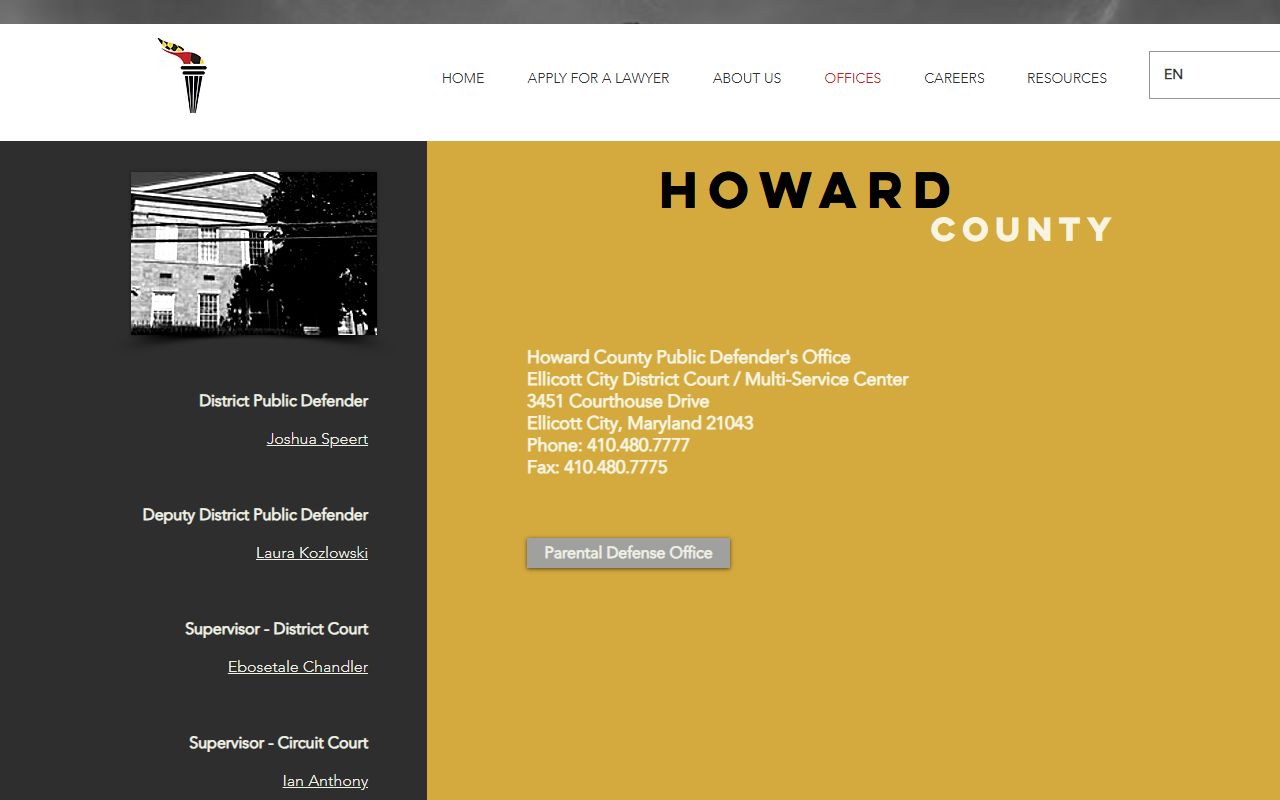
Defense contact information is relevant because public criminal records often show attorney appearances and case events that affect deadlines, plea posture, and court dates.
Important: Public court lookup is not a consumer report and should not be used for FCRA-regulated decisions.
Restricted Howard Criminal Records
Not every criminal record can be viewed by the public. Juvenile delinquency records are confidential. Expunged, shielded, or sealed charges do not appear through ordinary public search. Adoption, mental-health, minor identifying information, financial identifiers, and some protective or family-related material may be restricted. Active investigations, victim safety details, and law-enforcement records may also be withheld through non-court public-record channels.
When a criminal case does not appear online, the reason may be a spelling issue, court transfer, sealed status, expungement, juvenile confidentiality, or a non-court record request path. The best next step is to confirm the court, case number, and public status through the Clerk of the Circuit Court, the District Court clerk, or the appropriate Maryland Judiciary records process.